Showing posts with label memories. Show all posts

Saturday, 19 September 2015

Wishful Beginnings - David Bowie's masterful concept album 1.Outside,turns twenty.

Every so often, I blog about my influences, and there's no denying that David Bowie is one of them, both musically and artistically. 

Bowie's frequently misunderstood concept album, 1.Outside was released 20 years ago today (much to my disbelief). 


In September 1995 I was 17, and just starting a two year college course in computer graphics - a journey that got me to where I am today, and 1.Outside was an important part of that time and a soundtrack to that period. It was the right album at the right time. I was already a huge fan of David's work by this point, but this album changed everything. I guess it was my Ziggy Stardust. 

For 1.Outside, Bowie returned to his "Berlin-era" style of music, and was at his most adventurous; not afraid to play with concepts and characters, and re-introduced his famous 'cut-up' technique of writing (originally borrowed from William Burroughs), alongside some truly experimental, unusual and exciting music. Here is an album which - twenty years later - still sounds unlike anything else, thanks to the combination of brilliant musicianship from the band, which included Bowie stalwart Mike Garson, and innovative production work from Brian Eno. 
The music merges heavy industrial and electronic soundscapes with rock and even jazz elements, finished off with some of Bowie's most distinctive vocals. At this point in his career he was making the music he wanted to make, and wasn't afraid to take risks, venturing into new and cutting edge  territories – and the result was a dark and unsettling album, dense with energy and playful creativity - Bowie at his theatrical best. 

Songs such as The Hearts Filthy Lesson, No Control and I'm Derranged still sound incredibly contemporary, while The Motel ought to rank alongside Bowie's very best tracks. The album's variety comes courtesy of Wishful Beginnings, We Prick You and A Small Plot of Land, which stand out as some of David's most creative works. 

The story/concept itself follows a private detective, Nathan Adler, investigating a series of brutal "art crimes" at the turn of the century. The album introduces various characters and suspects Adle encounters in this seedy underworld, all portrayed by Bowie. Not for everyone, and not your run of the mill concept for an album. However you can take or leave the concept itself with no detriment to the music. 

Sadly the album wasn't given the warmest reception at the time, but in recent years, fans, biographers and the music press alike have all since recognised the album's strengths (just as with his 1977 album Low, slated on release, now regarded as a classic!). 

Release day came, and, ignoring the bad reviews - as any hardcore fan would - I rushed into Sheffield on a grey, Autumnal morning and went into Our Price (a record shop sadly no longer with us) to part with £15 (yes, new CDs used to cost that much) to get my hands on this much-anticipated new release. 

I've often had seasonal associations with music, and 1.Outside is no exception, perfectly matching the time of year it was released. Summer had all but faded and longer nights were starting to draw in. The first golden-brown leaves were appearing on pavements and bright mornings came with a glistening dew. Things were changing and evolving - including me, at such an impressionable and formative age - and the variety of musical styles and moods on the album, fitted like a glove. 

It simply had everything that caught my interests and fired up my imagination, from the music to the package design, which featured Bowie's own photo-manipulations and digital artwork. In 1995, Photoshop was still a pretty new thing (version 3 if memory serves) and ever the pioneer, Bowie had used it to create all the artwork in the booklet, while the album cover itself featured one of his traditional medium paintings. As ever, his finger was clearly on the pulse with new technology, as some of the album's lyrics even referenced the Internet - then in its infancy and far from the thing we take for granted at our fingertips today. It's these things which give 1.Outside such a contemporary edge. 

Granted, it isn't the most accessible album, but Bowie has never been one for a mainstream approach. I'd never been taken to a cinematic musical world like this before. It was like a David Lynch film, in album form (Lynch would actually feature tracks from 1.Outside in his 1997 film, Lost Highway). There was so much to be excited about, before even getting into the music itself! This was back in the day when album releases were big things, and worth getting excited about. 

This was probably the first time I had become completely obsessed with and addicted to an album. At the time, the album's visuals influenced my graphics work in my college projects, and years later, the album's atmospheres and textures influenced my own musical compositions. 

So having had the album on pretty much constant repeat following its release, something even better and more exciting was just around the corner - the chance to see David live in concert. 

December 3rd 1995 was a wet and rainy evening. Me and my friends could hardly believe that in just a few hours, we would be looking at David Bowie, just metres away. We weren't in the slightest bit bothered that the mismatched support act of Morrissey had pulled out. 

Reflecting the album's themes, the stage set was part artist's studio, part crime scene, comprising hanging beam lights, torn curtains, fabric cadavers, a table and chairs and a wooden sign reading "Ouvrez le chien". We were really starting to wonder what kind of show we were in for, when the house lights finally dimmed, and rubbery-smelling smoke billowed out into the auditorium, shrouding the stage.

David Bowie crept on to the stage, in a paint-stained, torn tshirt, sack-like trousers and no shoes. And he still looked charismatic and distinctive as ever. Only David Bowie could come on stage dressed like that, and still look amazing. We were close enough to see his different eyes, and his every move was captivating. I've never seen anybody with such a commanding and fascinating presence. You simply couldn't take your eyes off him. 

The show itself heavily featured the new tracks, with carefully chosen songs from his back catalogue reworked to suit. Bowie stayed true to his word of deliberately not playing a greatest hits set, and it worked a treat. Few artists today could get away with such a bold move when it comes to live performance. After the show, we were left wondering if we had really witnessed it!

The Sheffield Star gave the show a good review the following day, and it was simply special to see photos from the show in the paper. A great souvenir. 


This period remains one of my favourite Bowie phases. You'll notice the "1" prefixed in the title - David's original plan was to continue the story through a series of concept albums, but sadly this never saw the light of day - though despite this, part of me is still waiting or hoping for at least one follow-up!

I imagine that we're unlikely to be treated to such, and the material intended for the series will remain in Bowie's musical vaults. I've come to accept that, but it doesn't stop 1.Outside from still sounding brilliant and original, twenty years later. It really doesn't feel that long at all. Either way, the time is right for reappraisal and rediscovery, and I have to admit a slight tinge of envy for the new generations of Bowie fans who may just be discovering the music outside for the first time...

Wednesday, 21 January 2015

Digital Deluxe

Following on from the previous post about the joys of the Amiga home computer and the musical inspiration I gleamed from the games scene, it's now time to shift the focus on to art.

My journey into digital art began way back in 1990 at the formative age of 12. Up until that point, I had got by just fine with pencils and paper, without the addiction or distraction of a home computer. Of course, all that was about to change.

One day at school, our art teacher, Mr Cronin, took us to a dark and dusty corner of the art room, and introduced us to The Computer. Its was an Acorn Archimedes, and it had this thing called a Mouse – which looked like a house brick on a cable with a funky ball mounted in the underside. Mr Cronin then went on to demonstrate the power of a paint program, and the mouse swung into action.

This was the moment.

First he created a gradient from red to yellow, and before long we had a sunset! A few clicks of the mouse later and we had a house with windows. Wow. Up until that point, my only experience of computers were friends’ C64s or Spectrums that played pixely games with chirpy music. The notion of making artwork on the computer hadn’t even crossed my mind.

Mr Cronin then took the excitement up to 11 – by clipping out a section of the image and creating a brush… which he then zoomed around the screen and painted with, creating an impossibly crazy pattern.

I was sold. I’d seen the future.

I got home. “Dad – Can I have an Archimedes?” 

My pestering for one of these mysterious Archimedes machines went seemingly ignored, until one day when my Dad went out one morning and came back with this exciting new computer – a Commodore Amiga A500.

I still remember the squeak of the polystyrene packing as I extracted the Amiga from its box. Of course, the computer coming with the 10-Star Games Pack, would lead to a whole other distraction, but also in the bundle was this exciting looking software package entitled Deluxe Paint II…


Deluxe Paint – or Dpaint as it was usually referred to – was made by Electronic Arts and for a long time the main art/paint program on the Amiga. And it was the answer to all my artistic needs. The Amiga being smarter and more advanced that the Archimedes, Dpaint offered so many functions and hundreds of colours.  I’d soon be drawing cartoon illustrations, Daleks, space ships landscapes, you name it. All with the mouse, I should add! And as I progressed through later versions of the program, I’d explore the joys of even more colours and animation features too.

DPaint opened my eyes to digital artwork. I’d go on to design my own games on the Amiga, make comics, write stories and even do my school work at any given opportunity. 

Fast forward to the mid 1990s and my arrival on a college course in computer graphics and design. I was delighted to find a room full of Amigas. Of course, I already knew Dpaint inside out. The following year, it would all change and we’d be working on Macs and PCs running this new thing called Photoshop. But Dpaint’s user interface proved to be the perfect training ground for the more advanced Adobe software.

Some of the last work I ever did in Dpaint on the Amiga was some college coursework from that time – a journey inside a giant computer, giant engine and giant machine – and here it is! What fond memories.


Tuesday, 8 July 2014

Back Into the Light


This was my view. Well, one of many breathtaking views. Out of shot to the right, you’d eventually see the sea. Nobody else for miles around, epic views and that kind of special-smelling warm air and sea breezes that you get from being high up. The atmosphere up there in the Andalusian mountains was tranquil to say the least.

This was 7 years ago now, and round about this time of year. I’m always frustrated by the seemingly fast passing of time in such circumstances. You want to hold on to and preserve certain memories as much as possible and keep them close, as if they were yesterday.

I fondly recall reading Mike Oldfield’s autobiography Changeling – a revealing and inspiring book, well recommended. Reading the stories behind the making of his albums whilst looking at those mountains, with music drifting out from the villa was a great source of inspiration. It was here that I always claim my album Into the Light was born.

While I didn’t actually compose the music there, that place was where many of the ideas came and gradually filled up my head. I’d make mental notes of ideas for riffs or arrangements. The real challenge was to remember everything and try and capture it all once I returned home! It's rare to be able to describe something as perfect, but that really was, and I wanted to somehow bring that essence and optimism into the music.

Into the Light remains a very personal album for this very reason, as I feel I did capture what I wanted in the music. Every time I hear it, I’m transported back there.

Of course, this was just one small element of that stay in Spain, but the one connected to my music. A few of the album's tracks were made before this however, and had very different backgrounds! Two examples being "Beyond the Clouds", which was composed the day after a rather unpleasant stomach upset(!), and the title track came about after having a rather harrowing dream where I'd been shot, and was suddenly traveling towards, and into a blinding light.

And that's how the title came about.

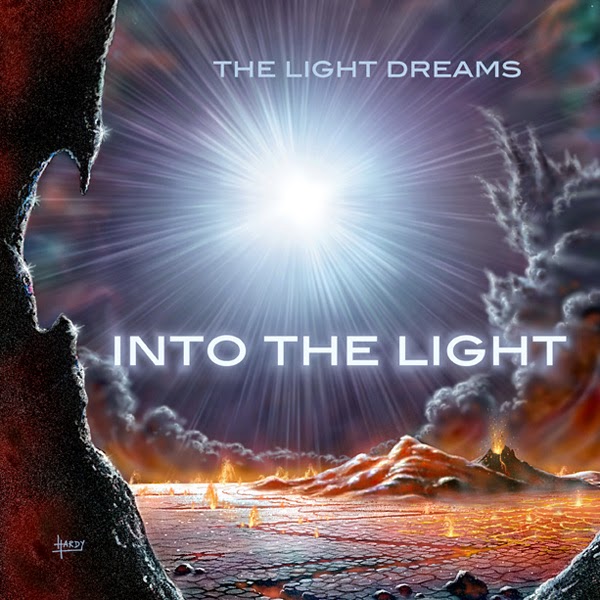
So Into the Light really is an album inspired by travel and dreams. Yet it also has an other-worldliness to it, which is perfectly reflected in David A. Hardy's beautiful cover artwork.

This particular painting caught my eye in 50 Years in Space: What We Thought then… What WeKnow Now, the wonderfully illustrated book Hardy co-produced with the late, great Sir Patrick Moore.

As an artist, I usually have quite a clear idea about how my album cover should look, and that it should also be my own work, as an extension of the music. But in this case, Hardy's painting leapt out of the page at me, and was just perfect. A few emails later and the album cover was there!

I regard Into the Light as my first proper album. My real début. I'd made several demo albums prior to this that were basically my exploration of sound and what I could do. But with this album, everything came together and fell into place, as a culmination of all those ideas that I’d experimented with over the previous year. As an early work, I guess it has its shortcomings and imperfections, but it wouldn't be the same without them.

In the autumn of 2007, the initial version of the album was up on MySpace for streaming and briefly on one or two other sites for download.

I didn't make another album I was happy with until 2009 with Mechanical Drive, but shortly after completing that project, I took my music offline and didn't make any for almost three years.

When I returned to making music in 2012 with Inferno, knowing I was going to have a go at actually selling my work online, one of my priorities was to return to Into the Light and give it a bit of a remix before putting it online, especially since several software upgrades had rendered some of the original sounds useless, so substitutes had to be found. As I was firmly back in the mindset of the album, I wrote a brand new piece of a similar style entitled “Cyclic”, which comes as a bonus track with the full album download.

Initially it felt too soon to be revisiting the album - but then it occurred to me, that I was in fact, finishing it off!

I'm still incredibly proud of Into the Light and it remains very special to me, almost like a bookmark of a certain point in life. It's also where the music of The Light Dreams really begins...


Friday, 25 April 2014

The places of Traces

When describing Traces as a reflective album, one of the many elements that influenced that mood was the idea of following the traces of your own past and the places you've been.

When you live or work in the same city for a long time, you gradually see it evolve. Places come and go, new buildings shoot up to the sky, old buildings get cleaned up and ruins come crumbling down. But even with all the changes that a city undergoes, you can still always pick out traces of the past, whether it's a poster stuck in an abandoned upstairs record shop window or a bit of graffiti that always seems to have escaped erasure.


And when you start looking closely, traces of history start to emerge – the imprint of old signs, remnants of old brickwork, a rusty street sign, old factory names still adoring buildings that now house flats and cafés, and bits of architectural detail high up at the tops of the buildings which have survived wars.

Once you start observing these things, you end up constantly noticing what used to be. A childhood cinema that’s now a clothes shop. A place where you bought your favourite albums that’s now an opticians or a place you enjoyed many meals that’s now long boarded up. 

It’s inevitable that you end up picking up your own traces of the places you’ve been and the memories of the people you were with. You walk past the office of your first job; now no longer in use, and think about the 20-year-old version of yourself that used to frequent there. The music you played at the time, the faces you knew and the life you had then, which has evolved along with the city in the intervening decades. It’s not that you wish to spend your time chasing ghosts but almost by default there’s a part of our brains that enjoy these reflections, triggered by our own invisible footprints and little fragments of personal history.

Traces is out now on Bandcamp.


Friday, 7 March 2014

Where dreams and reality converge...

You can't beat a good book.

The album packaging and PDF booklet that comes with the full download of Traces list several books and authors in the credits. As an avid reader, particularly of SF, I’m always rooted in a book, and this inevitably influences whatever I’m working on, whether it’s artwork or music.

Taking a bit of a break from science fiction, I’ve found myself more interested in what is often referred to as speculative fiction.

Last year I discovered the work of Christopher Priest. I’ve become addicted to his books. Dreams and realities converge, usually in very mysterious, unpredictable and harrowing scenarios. Priest also created the “Dream Archipelago”, a series of islands in an alternative reality, which is a recurring setting in several of his works. The Affirmation, The Glamour, The Extremes and his haunting inter-connected short story collection, The Dream Archipelago were all brilliant reads, and perfectly reflected the sort of mood I wanted to project through my music.

My friend and renowned space artist David A. Hardy had referred me to Graham Joyce’s début novel, Dreamside. This book – sadly out of print – took some tracking down, but I eventually got my paws on a first generation copy at last year’s Novacon. And it was worth the long search!

Dreamside explores the concept of lucid dreaming and follows a group of young students engaged in a series of dream experiments. They manage to cohabit the same space, which they call the “dreamside” – but things soon turn dark and disturbing as elements of the dreamside begin to seep through into reality. A compelling and gripping book from cover to cover, and like Priest, Joyce’s exploration of human psychology is just superb. I followed this up with one of Joyce’s latest books, The Silent Land, a haunting and moving work, written in a similarly gripping fashion. I certainly look forward to reading more of Graham’s work.

Having enjoyed Jame’s Smythe’s nightmare-in-space novel, The Explorer, I was keen to read his next work, The Machine. Described as “a Frankenstein for the 21st Century”, The Machine is set in the near future and is unsurprisingly, a story about a machine - designed to restore memories but subsequently banned by the government. The novel follows a young woman, Beth, who has come into illegal possession of one of the Machines, in an attempt to re-build her traumatised husband who has been emotionally and psychologically broken by war. The Machine takes you on the downward spiral with the characters in a bleak and unsettling read.

Over the last few years, I’ve also become a fan of cult Japanese author Haruki Murakami. While his books often verge on the absurd and surreal, he creates such engaging characters and vivid scenarios, it’s impossible to but his books down once you’ve picked them up. Again, we’re propelled into parallel scenarios and dreamlike environments in contemporary Japan, every page full of questions and surprises. IQ84, Kafka on the Shore, Norwegian Wood and Hard-Boiled Wonderland at the End of the World are just a few of his books really worth checking out.

With all of these books, the subtle transition between dreams and reality and reality/alternate reality was something that interested me and was the sort of atmosphere I was striving to create on Traces.

While my music isn’t a direct interpretation of any of the above (which, being instrumental, it would be difficult to do!), in my mind, it was almost like creating a soundtrack to what I was reading. Some of the imagery in the books, whether it was the sea view from the convalescent home in The Glamour, the fractured memories of The Machine or the blurred lines between dreams and reality in Dreamside really fuelled my ambition for the album – at least in my ears.

What I love about instrumental music is the fact that it can be thrown open to interpretation, aside from its initial or proposed premise. I’d love to hear from anybody who has bought a copy of Traces or streamed it online, and what kind of imagery it brought to mind.

Traces is out now on Bandcamp.