Showing posts with label album. Show all posts

Tuesday, 10 April 2018

Crossover - now available!

"A threshold is a challenge..."

These are the opening words of Richard Hayes' sleeve notes for Crossover. As always, Richard's words are perfect, instantly capturing the essence of what my music is about.


Crossover is available now, via Bandcamp, both as a digital download, and limited edition CD-R.

Although I would release all my music as a physical version if I could, this was one release which I felt needed to be made available on CD, and I'm delighted with how the packaging has turned out, really feeling like an extension of the music, as all album artwork should.


Crossover is made up of three tracks, with a total running time of just under 45 minutes. There's lots to explore...

To stream or purchase the album, point your browser to:


Wednesday, 4 January 2017

Infinity of Space blog 1 - the sight and sound of space

Instrumental music has enjoyed a long-standing relationship with the concept of space travel, as far back as Holst’s The Planets in 1914, Bebe Barron’s alien-sounding score to Forbidden Planet in the 1956 or even Joe Meek’s Telstar in 1962 and of course, the vast spectrum of progressive rock, space rock and instrumental electronic music that emerged in the 1970s.

In recent decades, despite there being no new space programme, mankind’s future in space – and how to get there – has remained an endless source of inspiration for artists, writers, filmmakers and musicians, myself included. But in this time, what many have turned to is a retro-futurism, recalling the excitement and ambition of the golden age of space travel during the 1960s and 70s.

Sometimes in order to look forward, you first need to look back. When I look at my own influences – both artistic and musical – they all emerged from that same, prolific and fruitful era.

In addition to this, I have always been fascinated with the notion of letting music create images in the mind and allowing my imagination to explore new environments through music – and I think we all need that escape. With no lyrics to distract or send the listener down a specific path, instrumental music works as a blank canvas for the imagination.

The images that we see in our mind’s eye are altogether different to when we are watching a concert or music video. While there's no denying the thrill and spectacle of a live show, our eyes and ears fight for attention, and sight usually wins. If you're watching something, then you're not always completely listening to it.

It is no coincidence that many of us like to close our eyes in order to fully enjoy and concentrate on music. Shut off the world outside and drift away. I have found that listening either in the dark or with eyes closed, an album or piece of music can take on a completely different mood to playing it in daylight or in the background.

When composing music with which to promote the Initiative for Interstellar Studies (i4is), a specific sound and atmosphere must be sought. What I want to achieve is music that encapsulates the concept of Space travel – from the construction of starships and their maiden voyage to the discovery of new worlds and galaxies – but that also reflects the ethos of i4is yet also leaving room for additional interpretation by the listener. Quite a challenge!

Composed and recorded throughout 2016, Infinity of Space is the title of my latest album project in association with i4is.

While there are no rules as to how such music should sound, I wanted to partly pay homage to the space rock of the 1970s through working with a guitarist on some tracks, for that classic instrumental rock sound, while others are more heavily electronic, exploring other-worldly atmospheres and textures.

Below is a first taste of the album, with a brief preview of the track, Absence (featuring Peter Rophone on guitar).


Infinity of Space is out now via Bandcamp:
https://thelightdreams.bandcamp.com/album/infinity-of-space

Friday, 11 March 2016

Leaving a Legacy


My first album of new material for this year is called Legacy. It is a project that came about very quickly – one of those instances when the ideas and creativity flowed almost effortlessly, and just kept on coming.

In fact, I had no plans to make anything new just yet, but as any artist, musician or writer (etc) will tell you, creativity is like an itch that just needs to be scratched – and I’ve been doing some serious scratching!

As I discussed in my two previous blog entries, the untimely loss of David Bowie has had quite a profound effect on me. Not only did I love every aspect of his music to the core, but I also learned so much from him as an artist. The day after that news broke, I found myself sat late at night with my thoughts, and I simply felt an urge to make music. No matter what the result, it was something I needed to do. So I fired up my Mac and plugged in the midi keyboard – and that was the starting point for when became Legacy.

And David has left an enormous legacy, one that will live on and inspire future generations. His music has never sounded more alive than it does right now, and my recent re-exploration of his work got me thinking about how his work has influenced my own music and my ways of thinking and working. Bowie always struck me as a very spontaneous artist, renowned for often nailing his vocals in the first take – and that spontaneity shows in the energy of his music. One of the many things I’ve always admired in his songs is the unique view of the world they instantly allow you to see – and that is what excites me about making (and listening to) instrumental music; there are no guiding lyrics, just the music for you to interpret as you wish. 

Some of David’s most emotive pieces include the haunting instrumentals from the Low and “Heroes” albums of his famed “Berlin” period of the late 70s. What fascinates me about those tracks is how textural and how organic they sound, despite being heavily electronic. That same organic feel can also be found on his largely under-valued albums of the mid-90s, The Buddha of Suburbia and 1.Outside – two of my personal favourites, and albums that sit perfectly alongside those Berlin albums. Sometimes the music is very simple, other times it is densely layered and complex, and I often find myself wanting to get inside those layers and really hear what its all made up from. I constantly strove to find a more textural and organic sound. To me, making instrumental music feels like building up a sonic landscape to explore – parts of it are carefully and intricately planned out, others are purely spontaneous. Sometimes the destination is clear, other times you find yourself in unexpected territory. David Bowie's music has not only been a soundtrack to my own life, but had it not been for his outlook and artistry, I may have never have felt the drive to try and make my own music.

Legacy is dedicated to David. In a way, it is my personal tribute and certainly the creative process was my own way of dealing with this loss. I found myself grappling with the same issues we all do when somebody we admire has left us – those supressed questions and thoughts bubble back up to the surface, and you find yourself looking backwards; longing for what’s been and gone. But this was just the starting point for the project – I certainly didn’t anticipate making an album’s worth of material.

But every project needs an origin, and once you have that starting point, you can explore all the places it leads you, as it takes shape and finds direction.

Much of the above may sound a little downbeat, and it has resulted in some reflective and nostalgic music. But I would prefer think of the music of Legacy to be more thought-provoking rather than gloomy in any way. Granted, it is very dark in places, but in contrast, it has its equal share of light and optimism. I also wanted to work very spontaneously, keeping most first takes and leaving that slightly raw feel. It can be so easy to lose that spontaneity and immediate mood or emotion through too much refining and polishing.

Most of all, what I wanted to achieve with this set of songs was a sense of journey and transformation – whether that is a journey into the future or a rummage back through the past, is up to the listener.

While I found myself revisiting some familiar motifs in the music, most of the sound palette on the album is fresh. Only on a couple of tracks did I allow myself the use some of my comfortable, trademark sounds – simply because they were the only ones that really worked. But one of the ‘rules’ I gave myself for Legacy was to work with a new soundscape where possible. Even something like a string sound – rather than going straight to ones I’d used previously, I’d look through new ones, or try something unexpected.

I can’t remember how the title came about. It may have been one of those moments when a particular word suddenly stands out from the page of a book or something, but “legacy” popped up and seemed absolutely perfect for the project.

Assigned with the regular duty of writing sleevenotes, my good friend Richard Hayes came up with some marvellous wording that not only encapsulates the underlying mood of the album, but that compliments the music and helps throw it open to interpretation:

Life is full of experiences.  From the everyday and mundane to the exceptional and life-changing, they mould and develop us to be what we are today.


Legacy is available now, via Bandcamp.
The full album download comes with a PDF booklet containing Richard Hayes' specially-penned sleeve notes.

Tuesday, 10 November 2015

New album: TIMESHIFT


Time flows around us.  It swirls and eddies through our lives, changing our view of what is happening around us every moment, of our memories of the past, and of our hopes for the future.  Nothing stays the same – there is perpetual movement and we may feel helpless in the midst of its flow.

This is an excerpt from the wonderful introduction written by Richard Hayes, for my new instrumental album, Timeshift.


When making an album I nearly always begin with a concept and a title, and work backwards from that. With Timeshift, this was not the case. I had started off composing some new music for the simple pleasure of making music, and from that, other tracks emerged. Soon I was on a roll. But there was no theme, at least back then. And there certainly wasn't an album title.

Themes gradually began to emerge as I produced more music, and one recurring mood was that of night. The images of rainy city streets, illuminated architecture and the way familiar scenes are transformed by the setting of the sun and the onset of night.

This is also the time when we dream, and our minds take us on unanticipated adventures as we visit worlds that we can only see through the medium of sleep. I've always found it fascinating how you can have a dream which lasts for hours or even days – complete with nights in between – yet you've actually had that dream in a matter of minutes.

In my mind, the moods and atmospheres of the music I was making reflected this, but also as the basis for a very Earth-based album, which looks at the passing of time and the general uncertainties you face in life. I've spent a lot of time making music with a space or science fiction concept, so at least for me, it was refreshing to make music that in my ears, felt at home when you're simply walking around town.

At the same time, instrumental music is not unlike an abstract painting, in that the music is open to interpretation, and you can make of it what you want.

As a synesthete, the colour of the music is ever at the forefront of my imagination, and this is often reflected in the album artwork. When making the album, I was seeing a lot of blacks and greens, with occasional shimmering gold. The album artwork came together very quickly – sometimes this is a lengthy process, and hard to get right. Other times, you get it right first time, which was the case here! Once the artwork was in place, I knew it would decide what it wanted to be called soon after. Within the last couple of weeks of mixing the album, the title Timeshift came about.

Now, it's over to you...

Timeshift is available via Bandcamp, priced £7. 
The full album download comes with a PDF booklet.


Monday, 19 October 2015

Review: Electronica 1 – The Time Machine

I've cited Jean-Michel Jarre countless times as a major influence on my own music, so its only right to dedicate a post to my first impressions of Electronica 1 – The Time Machine, his first album of new material since 2007.

The Time Machine is the first part of a double album collaboration project, Electronica, with the second volume due for release in April.

On the one hand, it's easy to wonder why, after eight years Jarre has decided to return with a collaboration project, rather than a new album all of his own creation. But when you consider his long career – which took off in 1976 with the pioneering electronic opus Oxygène – the one thing he hasn't really done in that time, is teamed up with other artists he admires, and that's exactly what we have here.

Whether you paint or make music, this is usually a solo venture. Yet, put a likeminded person in there with you, and you soon find new ideas emerge and you bounce off each other's creativity, with fruitful results.

Jarre hasn't simply teamed up with artists currently in vogue, or your stereotypical cult figures of electronic music, but those who are important to him; artists whose music has influenced his own, or those currently on his own musical radar. This makes for a truly fascinating country-spanning album. The album is almost a travelogue in its own right, as Jarre physically travelled around the world to meet up with each and every artist in the project, to discuss face to face and actually work together – a refreshing move, when by today's standards, a musical 'collaboration' typically evolves around a lot of emailing of files, and not actually meeting up with the other artist.

When you look at the list of names on the album – which includes Vince Clarke, M83, Air, Little Boots, Laurie Anderson, Moby, Pete Townsend, Massive Attack and Tangerine Dream, to name just a few – it would be easy to assume this album might sound like a mixed bag or a compilation, but how wrong you would be to take such a viewpoint! Despite the wide variety and styles of artists on the album, there is a consistency in approach and in sound. Each track is after all, built around an original demo by Jarre, so his musical stamp runs coherently throughout. You'll hear sounds from across Jarre's back catalogue, including a welcome return of his iconic laser harp.

After only having had the album for a few days, it's still too early to pick out firm favourites, but instant standout tracks include the title track (with Boys Noize), Automatic pt1 & 2 (with Vince Clarke), Suns Have Gone (with Moby), A Question of Blood (with horror maestro John Carpenter), The Train and the River (with Lang Lang), Glory (with M83) and Zero Gravity with Tangerine Dream.

Zero Gravity is perhaps the most poignant track on the album, being recorded just a short time before Edgar Froese sadly passed away – and Jarre has respectfully dedicated the project to Froese.

The combination of Jean-Michel Jarre and French electro-duo Air will no doubt please fans of both artists, as not only is it a perfect match, but a huge technological achievement, in a recording that spans the history of electronic music technology; starting out with a sampled drum loop assembled on a continuous analogue tape loop (sellotaped together!), going through a range of different analogue and digital synthesisers and culminating with a melody played on an iPad!

There is an enormous amount of work and talent on this album, and this is evident right from the first listen – it's a truly epic experience, musically and sonically. Even with so many contributing artists, it still holds together as a Jean-Michel Jarre album, and arguably his best release in a long time. Certainly well worth the wait.

But this is just the first half of the Electronica journey. With names such as Gary Numan and Hans Zimmer on board for Electronica 2, next Spring simply won't come quick enough!


Sunday, 14 June 2015

Panoramic music

This week saw the release of Panorama, my fourth album of instrumental music in support of the Initiative for Interstellar Studies (I4IS). 


While open to interpretation to a degree, my basic idea when composing Panorama, was 'music for a new world'. I was starting to imagine what kind of alien vistas that may stretch out before us, as we take our first steps on a newly discovered hospitable planet. The concept of my previous album for the Initiative, Beyond the Boundary, was space flight and a journey, so to follow that up with the discovery and exploration of a new world – the destination – seemed like a logical step. 

Work on this album actually began in April 2013, not long after I'd released Traces. However, despite working up several demos, I hit a block early on, and it would take a long time - many months - before an album of any form was starting to take shape. 

The first piece of music I made was actually the opening track, Touchdown. This seemed perfect right from the start, as a transitionary track between the interstellar flight of Beyond the Boundary, and the uncharted territory of Panorama. The final mix of the track is almost all the original demo - it is slightly raw and untamed in places, but for me it just worked like that, and over working the track would have risked losing that initial feeling.

Hear Touchdown on Soundcloud.

The title Panorama came quite early on, too. This was music for landscapes and huge vistas. Widescreen images in the mind's eye. And once that title was in place, the music and ideas began to flow, clearing the creative block I'd experienced at the start of the project.

Hear Panorama on Soundcloud.

One of my early plans was to make an album with no drums or percussion at all. This is something I've dabbled with in the past, and really wanted try. But it didn't turn out that way, so maybe the drum-free album will be a future project! However, Panorama does have several sparse, minimal pieces true to my drum-free idea, one of which is Aurora - perhaps one of the most evocative and atmospheric tracks on the album. At some point I was even considering this one for the title track. Aurora was another track from the early stages of the project, which just came out perfectly in one take. 

The main challenge throughout the process was how to make music for a world that I cannot see or visit, but can only imagine?

I spent time looking at the Mars Rover's photographs of the planet surface, my favourite space and SF art, and of course, films, gleaming inspiration from things like the water world and ice planets in Interstellar and even the dream-like sequence at the end of Contact. The list goes on!

But the music also needed a sense of mystery to accompany the notion of exploration and discovery, and those ideas started to flow once I created the middle section of what became Crystal Cavern. Until then, it was just a demo track of the first couple of minutes, lacking direction. And it turned into one of my favourite tracks on the album, also reminding me of the kind of approach I took with my first album, Into the Light, in 2007. 

I'll be the first to admit that Panorama was a difficult album to get right. I even took a break from it for a few months while I made Future Worlds Redux and Sentient City! But giving it some time and distance, was just what it needed, as when I returned to it, all the pieces suddenly fitted together. Once I had made the title track, the rest of the ideas all emerged.

The final album comprises 15 tracks, plus a short bonus track when you purchase the full download. Rise was a piece of music I composed for the I4IS after their involvement in the Shackleton 2 helium balloon project, which saw a probe boasting the I4IS logo travel to 90,000 feet into the Earth's stratosphere, then take a selfie! So while not directly related to the theme of the album, it felt appropriate that Rise should feature in an album supporting the Initiative.

Monday, 22 September 2014

Back... to the Future (a science fiction symphony)

Orchestral soundtracks have long since dominated the film industry, particularly in science fiction, with classic scores such as Star Wars, Alien, Terminator or Total Recall. And you can enjoy a good film soundtrack as an album in its own right. 

I wanted to make an album that captures the essence of this kind of soundtrack, with an emphasis on drama and atmosphere. And I think I’ve achieved that with my new release, Future Worlds Redux.

Until now, I’d never been one to re-visit music previously deemed completed. When my favourite artists have released a new album of reworks of older songs, I often saw it as a disappointment or sign that they’re out of ideas. I was wrong.  With distance and hindsight, you can really see where your best bits are, and where you can expand your work to realise its full potential – stuff that perhaps wasn’t evident first time round. I guess we can call it artistic satisfaction. Sometimes you just need to put a bit of distance in to see what you need to do.

The problem many an artist faces, whether we’re talking music or artwork, is never quite knowing when something is finished. In truth, nothing is ever complete, not really. There just comes a moment when it feels right, and you stop. Otherwise you’d be niggling away at it for months or years and never get the thing finished!

I was really proud of my original Future Worlds album, which I started working on in Autumn 2012, and released in February 2013. It was made during a personally difficult time, and was a great cathartic experience as well as realising my ambition to make an album inspired by classic science fiction books and scenarios. 

But at the same time, something at the back of my mind was left unfulfilled – an annoying "unfinished" feeling, perhaps because I had originally intended to make an orchestral style album, following on from the Road to the Stars soundtrack I produced for David A. Hardy. But thanks to my love of synth sounds, Future Worlds ended up a fusion of the two styles, with the electronics taking centre stage.

Almost two years later, I felt enough time had passed to finally revisit the album and rework the tracks into symphonic versions as I had originally intended. I always wanted Future Worlds to play out like one of those great  science fiction film soundtracks. 

Not only was this a relatively quick process, but it was great fun, getting back in to the vibe of those songs and realising I still very much enjoyed them, and that there was still a lot of life in them. This was an opportunity to move things around and expand and change the arrangements to suit the orchestral approach, as I didn’t want to make the same album with different sounds.

In addition to changing the order and arrangements, I also went through my unfinished demo files from when I made the original album, and found one that I felt had some potential to work up as a new addition. The original album came with two bonus tracks which I liked a lot – in hindsight they should have been more than just bonus tracks, so this was the opportunity to give them a new home.

And that “unfinished” feeling has now been upgraded to “Complete”.


Tuesday, 8 July 2014

Back Into the Light


This was my view. Well, one of many breathtaking views. Out of shot to the right, you’d eventually see the sea. Nobody else for miles around, epic views and that kind of special-smelling warm air and sea breezes that you get from being high up. The atmosphere up there in the Andalusian mountains was tranquil to say the least.

This was 7 years ago now, and round about this time of year. I’m always frustrated by the seemingly fast passing of time in such circumstances. You want to hold on to and preserve certain memories as much as possible and keep them close, as if they were yesterday.

I fondly recall reading Mike Oldfield’s autobiography Changeling – a revealing and inspiring book, well recommended. Reading the stories behind the making of his albums whilst looking at those mountains, with music drifting out from the villa was a great source of inspiration. It was here that I always claim my album Into the Light was born.

While I didn’t actually compose the music there, that place was where many of the ideas came and gradually filled up my head. I’d make mental notes of ideas for riffs or arrangements. The real challenge was to remember everything and try and capture it all once I returned home! It's rare to be able to describe something as perfect, but that really was, and I wanted to somehow bring that essence and optimism into the music.

Into the Light remains a very personal album for this very reason, as I feel I did capture what I wanted in the music. Every time I hear it, I’m transported back there.

Of course, this was just one small element of that stay in Spain, but the one connected to my music. A few of the album's tracks were made before this however, and had very different backgrounds! Two examples being "Beyond the Clouds", which was composed the day after a rather unpleasant stomach upset(!), and the title track came about after having a rather harrowing dream where I'd been shot, and was suddenly traveling towards, and into a blinding light.

And that's how the title came about.

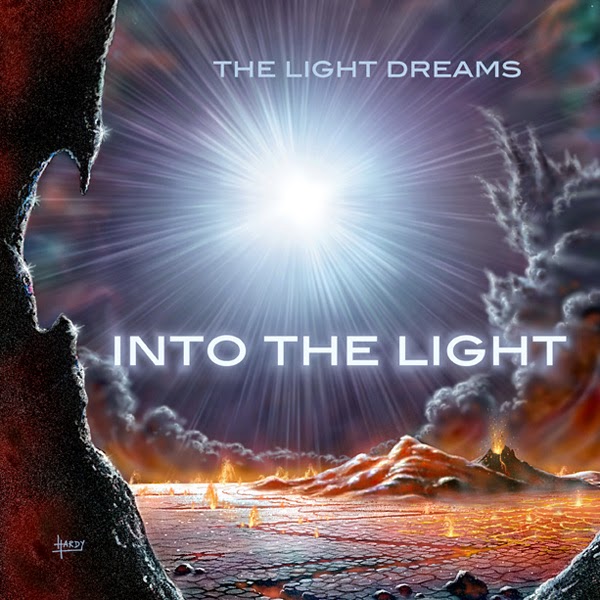
So Into the Light really is an album inspired by travel and dreams. Yet it also has an other-worldliness to it, which is perfectly reflected in David A. Hardy's beautiful cover artwork.

This particular painting caught my eye in 50 Years in Space: What We Thought then… What WeKnow Now, the wonderfully illustrated book Hardy co-produced with the late, great Sir Patrick Moore.

As an artist, I usually have quite a clear idea about how my album cover should look, and that it should also be my own work, as an extension of the music. But in this case, Hardy's painting leapt out of the page at me, and was just perfect. A few emails later and the album cover was there!

I regard Into the Light as my first proper album. My real début. I'd made several demo albums prior to this that were basically my exploration of sound and what I could do. But with this album, everything came together and fell into place, as a culmination of all those ideas that I’d experimented with over the previous year. As an early work, I guess it has its shortcomings and imperfections, but it wouldn't be the same without them.

In the autumn of 2007, the initial version of the album was up on MySpace for streaming and briefly on one or two other sites for download.

I didn't make another album I was happy with until 2009 with Mechanical Drive, but shortly after completing that project, I took my music offline and didn't make any for almost three years.

When I returned to making music in 2012 with Inferno, knowing I was going to have a go at actually selling my work online, one of my priorities was to return to Into the Light and give it a bit of a remix before putting it online, especially since several software upgrades had rendered some of the original sounds useless, so substitutes had to be found. As I was firmly back in the mindset of the album, I wrote a brand new piece of a similar style entitled “Cyclic”, which comes as a bonus track with the full album download.

Initially it felt too soon to be revisiting the album - but then it occurred to me, that I was in fact, finishing it off!

I'm still incredibly proud of Into the Light and it remains very special to me, almost like a bookmark of a certain point in life. It's also where the music of The Light Dreams really begins...