Monday, 18 August 2014

Post-virtual Loncon

So Loncon 3 is over – and by all accounts it has been the highest-attended Worldcon event to date, with over 10,000 members at the last count. Recently described in a news article as an “art form”, it seems that science fiction has never been healthier. A lot of people enjoy SF for escapism, and you only need tune into the news for a daily plethora of distressing and misguided events in this world to realise why people crave for temporary escape.

While I did not attend Loncon 3 personally, I had a display of SF-themed art in the main art show and a couple of large prints on display as part of the Initiative for Interstellar Studies (I4IS) stand. I also designed several flyers, t-shirts and art postcard packs for I4IS recently, so it was great to have that presence too. By all accounts, the I4IS stand received the attention it deserved – perhaps helped along by their giant 2001-esque monolith with moving images projected on to it, and special guest speaker, renowned SF author Alastair Reynolds.

So it’s interesting to have been a part of this enormous event, even though I wasn’t actually there. Personally, I’m not a fan of large events, so aside from missing the chance of meeting several of my favourite artists and authors, I was quite happy to have been a non-attending member.

So what’s next? I’m currently working on new artwork, and my next project will be another music album for the I4IS. I’ve got a lot of ideas I’m quite excited about and keen to develop further. Event-wise, the next big thing will be Novacon 44, where I plan to have a display of brand new and recent artwork, totally different to what was on show at Loncon.

What I do love about Novacon is its more literary and scientific slant – no costumes in sight! However it does have its share of film and television SF, and it’s a great place to chat about Doctor Who or any other cult SF show for that matter. But Novacon does feel like a family – many familiar faces each year alongside new faces. Novacon is just the right size for me - big enough to be busy but small enough to be able to talk to people more than once. And I’m really hoping that many folk who attended Loncon will also attend Novacon this year. Hopefully there’s enough time between the two events for it not to seem like SF con–overload!

See my website for a photo of my Loncon 3 art display as well as general news round-up.

Tuesday, 8 July 2014

Back Into the Light


This was my view. Well, one of many breathtaking views. Out of shot to the right, you’d eventually see the sea. Nobody else for miles around, epic views and that kind of special-smelling warm air and sea breezes that you get from being high up. The atmosphere up there in the Andalusian mountains was tranquil to say the least.

This was 7 years ago now, and round about this time of year. I’m always frustrated by the seemingly fast passing of time in such circumstances. You want to hold on to and preserve certain memories as much as possible and keep them close, as if they were yesterday.

I fondly recall reading Mike Oldfield’s autobiography Changeling – a revealing and inspiring book, well recommended. Reading the stories behind the making of his albums whilst looking at those mountains, with music drifting out from the villa was a great source of inspiration. It was here that I always claim my album Into the Light was born.

While I didn’t actually compose the music there, that place was where many of the ideas came and gradually filled up my head. I’d make mental notes of ideas for riffs or arrangements. The real challenge was to remember everything and try and capture it all once I returned home! It's rare to be able to describe something as perfect, but that really was, and I wanted to somehow bring that essence and optimism into the music.

Into the Light remains a very personal album for this very reason, as I feel I did capture what I wanted in the music. Every time I hear it, I’m transported back there.

Of course, this was just one small element of that stay in Spain, but the one connected to my music. A few of the album's tracks were made before this however, and had very different backgrounds! Two examples being "Beyond the Clouds", which was composed the day after a rather unpleasant stomach upset(!), and the title track came about after having a rather harrowing dream where I'd been shot, and was suddenly traveling towards, and into a blinding light.

And that's how the title came about.

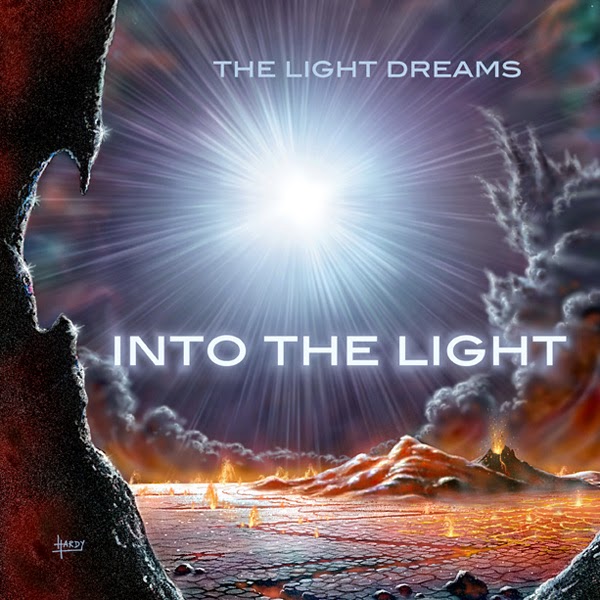
So Into the Light really is an album inspired by travel and dreams. Yet it also has an other-worldliness to it, which is perfectly reflected in David A. Hardy's beautiful cover artwork.

This particular painting caught my eye in 50 Years in Space: What We Thought then… What WeKnow Now, the wonderfully illustrated book Hardy co-produced with the late, great Sir Patrick Moore.

As an artist, I usually have quite a clear idea about how my album cover should look, and that it should also be my own work, as an extension of the music. But in this case, Hardy's painting leapt out of the page at me, and was just perfect. A few emails later and the album cover was there!

I regard Into the Light as my first proper album. My real début. I'd made several demo albums prior to this that were basically my exploration of sound and what I could do. But with this album, everything came together and fell into place, as a culmination of all those ideas that I’d experimented with over the previous year. As an early work, I guess it has its shortcomings and imperfections, but it wouldn't be the same without them.

In the autumn of 2007, the initial version of the album was up on MySpace for streaming and briefly on one or two other sites for download.

I didn't make another album I was happy with until 2009 with Mechanical Drive, but shortly after completing that project, I took my music offline and didn't make any for almost three years.

When I returned to making music in 2012 with Inferno, knowing I was going to have a go at actually selling my work online, one of my priorities was to return to Into the Light and give it a bit of a remix before putting it online, especially since several software upgrades had rendered some of the original sounds useless, so substitutes had to be found. As I was firmly back in the mindset of the album, I wrote a brand new piece of a similar style entitled “Cyclic”, which comes as a bonus track with the full album download.

Initially it felt too soon to be revisiting the album - but then it occurred to me, that I was in fact, finishing it off!

I'm still incredibly proud of Into the Light and it remains very special to me, almost like a bookmark of a certain point in life. It's also where the music of The Light Dreams really begins...


Friday, 20 June 2014

Lethal Seasons trailer

Nowadays, it's the norm for a book to have it's own visual trailer or teaser in the same way movies do. And why not?

So when I was designing the book cover to Alice Sabo’s Lethal Seasons, I started to imagine how I could use elements of the artwork for a simple trailer that would bring it all to life. So I gave it a go, with text and guidance from Alice – and here are the results:


I had originally set this to the somber tones of my track “Souvenir of Earth” from Future Worlds, and tried a second version with “Outsider” from Traces for a darker, more menacing atmosphere. Then it occurred to me that I ought to compose a new piece especially for the trailer – something with an ominous, threatening atmosphere, gradually building... and the Lethal Seasons theme came into being!

Tuesday, 17 June 2014

You still can't beat a good book...

These days, I’m an avid reader. An overnight break between two books tends to be all I allow, before impatiently starting the next. But despite growing up a science fiction fan, I didn’t start reading SF until I was in my early twenties, just after the turn of the millennium. The first SF book I got my teeth into, was Arthur C. Clarke’s The City and the Stars, which remains my favourite SF novel to this day. But despite subsequently reading several of Clarke’s works, I didn’t become a regular reader until relatively recent years, when I became absolutely immersed, obsessed and addicted to the genre (focusing mostly on Gollancz’s “SF Masterworks” range).

However, one day my wife unexpectedly bought me After the Quake, a book of connected short stories by Japan’s best-selling author, Haruki Murakami. I’d never heard of him, but was instantly drawn into Murakami’s juxtaposed worlds of contemporary Japan and dream-like scenarios and alternative time streams. This proved to be a welcome break from classic science fiction – metaphorical, hysterical, sexy, dark, harrowing and generally fascinating, Murakami’s stories are works of wonder with characters you get to know much more intimately than you might expect.

And it was around the same time that a friend recommended the work of British author Christopher Priest (you may have seen his name crop up in several of my recent blog entries). Priest’s 1981 novel, The Affirmation (part of the Gollancz range, complete with an Escher-esque cover) explores the merging of worlds and identities, and also introduces The Dream Archipelago, which would go on to be a recurrent setting in his books. Like any great novel, The Affirmation doesn’t show its age, and still reads as a contemporary masterwork. But as with Murakami’s work, I really enjoyed the blurred lines between dreams and reality that the book presented. Similar crossovers into seemingly alternative realities (often in the form of the Dream Archipelago) are the focal point of many of the author's later works; two particular favourites of mine being The Glamour and The Dream Archipelago; a series of short stories set around the different islands, with some pretty disturbing and thought provoking moments! And Priest’s latest book, The Adjacent (which I’m still reading, at the time of writing this) has certainly lived up to expectations.

This is the kind of writing which makes you stop, think and ask questions.

As somebody fascinated with dreams and the subconscious, and as a believer in fate and coincidence, this kind of writing instantly appealed to me. It is also harder to categorise, if you’re into such things; some call it fiction, others speculative fiction, or even fantasy. But in this, I feel I’ve really found the kind of book that I connect to, and which really fires up my imagination – in a different way to how futuristic SF novels do.

As I have previously mentioned, it was books such as these which provided additional inspiration for my latest album of electronic music, Traces. It’s much harder to illustrate such themes via instrumental music, but as my work is all about mood and atmosphere, I was more concerned with trying to capture that; almost like writing a soundtrack to the books I was reading at the time. 

So at present, the main source of inspiration for my music and artwork comes from whatever I’m reading. I’ve found that you can appreciate and respect an author and their works in just the same way as you can a musician and their albums. Books, like albums can become quite personal experiences. You can re-visit and re-discover albums and books, and never tire of them.

Wednesday, 11 June 2014

Let's go interstellar...

An exciting momentum is gathering with The Initiative for Interstellar Studies (I4IS). Within the last week, I4IS became incorporated in the United Kingdom as a not-for-profit company, and also launched a fantastic new website at i4is.org.

I4IS will have a strong presence at this year’s Loncon3 in August, so be sure to find their stand – and trust me, you won’t miss it!

As an honorary artist/musician for I4IS, one of my aims is to promote the Initiative and reflect its visionary values through my artwork and music. My latest release for I4IS is Beyond the Boundary, a musical journey beyond the stars (released as a digital download via Bandcamp in December).

Beyond the Boundary also shares its title with a forthcoming I4IS book, to which I also contributed, due for publication this summer. The book features contributions from members across the organisation on diverse subjects such as the scientific and societal benefits of interstellar exploration, defining the fundamental requirements, the use of wormholes and faster than light travel, interstellar communications, launch vehicles and many other chapters – my own being focused on the relationship between music and the stars.

As well as the website, you can also follow I4IS on Twitter and Facebook to keep up-to-date with all things interstellar.


Thursday, 29 May 2014

Oxygène... remastered

Jean Michel Jarre's pioneering album Oxygène has just been remastered and reissued along with half a dozen of his other albums. Anybody who has followed my work or read my website will already know my adoration for Jarre's music – without this album, I probably wouldn't have ever attempted making my own music.

Everybody has a particular album that they grew up with, and that had a particular influence or even life-changing effect – for me, Oxygène is one of those albums. It slots right into my creativity and way of thinking.

Although it doesn't cater for every taste, for me, it is one of those timeless, tireless albums. In a strange way it sounds both of its time and ahead of its time – at the same time! Though the album may be pushing 40, I still get the same excitement, inspiration and escapism from it as the first time I heard it in the early 1980s. The 2014 remaster comes with new liner notes and faithfully restored artwork (and a slightly bolder typeface if you want to be really picky!), but the music sounds as fresh as ever – in fact I even heard some bass notes that I'd never noticed before.

A feast for both the ears and imagination, there's an almost organic quality to the music through its evolving textures and atmospheres – hard to believe it was recorded on a mere eight tracks!

While Oxygène is the album that propelled Jarre to superstardom and defined an era of electronic music, it's easy to overlook the fact that it very nearly didn't get released at all.

In 1976, the 28-year-old Jarre's small Parisian apartment was a mass of analogue synthesisers, keyboards and drum machines, spilling through into his kitchen where an eight-track tape recorder would capture the burbles and swirls that would be part of the defining and distinctive sound of Oxygène.

Having composed and recorded this electronic opus of six movements all by himself, Jarre was repeatedly turned down by the French record labels on the grounds they could not market music with no vocals or that was not radio-friendly. French publisher Francis Dreyfus eventually saw potential in Jarre’s work and tentatively pressed 50,000 copies. Nobody was quite prepared for the global success of the album, that would go on to sell in excess of 15 million copies!

That little story in itself always inspires me - as it should inspire any musician or artist. When I listen to the album, although part of my mind wants to drift away with the sounds, I think about Jarre's struggle in 1970s Paris; surely one of the first home-based "D.I.Y" electronic musicians, of which I am now one, among countless others, thanks to the wonders of modern technology.

But this is the one album I always turn to when it comes to making music. The fact I can still gleam something new from it after hearing it thousands of times and that it still somehow drives me to make my own kind of music is something I'm constantly grateful for.


Friday, 16 May 2014

Convergence

It’s been extremely rewarding to see how well my new album Traces has been received – by my standards. It’s even been reviewed, which is great! As an unsigned, purely independent artist, you never know whether you’re doing the right thing or even making the right music! But as I’ve always said, if you’re doing something that you’re really fired up about, there’s bound to be likeminded folk out there who’ll also love it. The hard part is reaching them, and that is perhaps one of the main things that the internet has made easier (in theory). That’s when the real hard work starts!

Traces took just less than a year to make. Granted, my work doesn’t go through the various mixing and mastering or even production processes that a signed artists’ work would. It’s entirely the creation of my home setup, as technology has allowed artists to work that way these days. But making music is like doing sculpture – it’s an intensely private and personal process – you spend ages chipping away and shaping it up… and one day you unleash it. To simply have the ability and facilities to do that is brilliant – and one of the reasons I prefer Bandcamp as a platform. I would certainly encourage any independent musician to give it a go.

As I’ve said before, the over-arching theme to Traces is dreams and the subconscious – and a look into that crossover point between dreams and reality. If you buy the album as a download or on CD, you’ll see in the artwork reference to several books, which I read during the making of the album. Two of these are The Glamour and The Dream Archipelago by Christopher Priest; both works which perfectly captured the essence of what I wanted to convey into the music (whether you take that into account as the listener or not). I’m currently reading Tourmaline by James Brogden which is of a very similar theme. 

I often talk about there being a convergence with my music and artwork - this seems to happen whether I like it or not! The combination of reading those books and making the album inspired me to paint a scene from one of my own dreams, which I had a good 15 years ago now. But Scene from a Dream could easily have been the cover art to the album, had I not already designed it.

That dream was so vivid. Feeling the warm sunrise as I stood on the edge of some sort of dam or wall, with the city perimeter around me and the sea out in front. And not long after, I was taken straight back into that same dream when I heard the lyrics to "Quiet City" by John Foxx for the first time, from his 2001 album, The Pleasures of Electricity.

Convergence seems to be inevitable!